
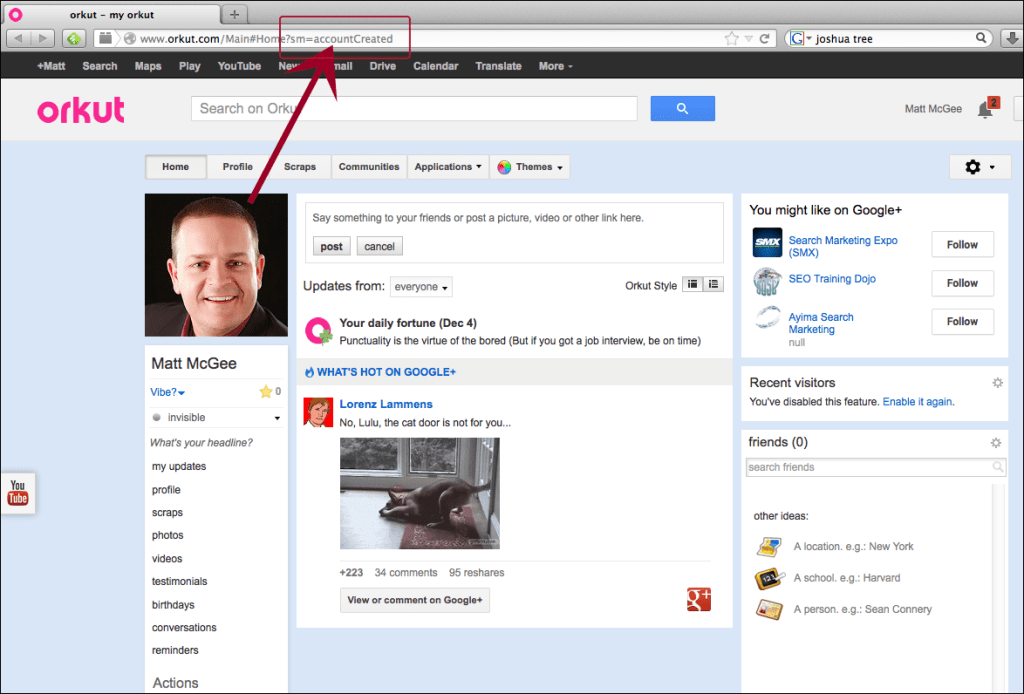
Orkut, created by Google employee Orkut Büyükkökten, was launched in 2004. Although it did not gain traction in the United States due to a crowded social media market and was ultimately discontinued, it became extremely popular in Brazil, where 90% of its page views were generated by Brazilian users.
The platform was structured like other social networking sites, but its primary focus was to help users discover communities through keyword searches. Within four months of its launch, Orkut had over 50,000 established communities, and after one year, that number skyrocketed to 1.5 million. Most users were interested in connecting with classmates, friends, colleagues, and local neighborhood groups, but it was particularly popular among technology workers and students.
Overall, the app had a simple yet sophisticated structure that made it easy for users to navigate and join communities. Users could blog, share photos and posts, and add apps and games. They also had the ability to connect with friends, participate in polls and group forums, and share videos from platforms like YouTube and Google Video. Additionally, it featured a “like” button similar to that of Facebook.
Social Media Consumers are a Function of technology and Culture
Brazil has become one of the strongest markets for online retailers, ranking as the fifth largest in the world. A significant number of Brazilians are active users of digital and social media; 77% have a positive view of online shopping, and four out of five use social media to research products. Most users also trust recommendations from their online contacts more than other sources. Social media and online shopping have become integral parts of everyday life for Brazilians, similar to trends seen in many other countries.
Orkut’s Eventual Failure
For companies to succeed in the Brazilian market, they must engage users through social media, as it has become an essential part of daily life for connecting with others in online communities. Orkut eventually declined because its original infrastructure struggled to accommodate its large user base, resulting in outages and performance issues. Additionally, it lacked features such as a news feed and privacy settings, which made it difficult for Orkut to compete with other social media platforms like Facebook. Moreover, its global reach was limited; while it was popular in Brazil and India, it failed to gain traction in other markets.
Failure to Evolve
Part of Orkut’s downfall was its failure to evolve and prioritize user needs and expectations. For social media apps to remain relevant, they must constantly seek user feedback to stay ahead of the market.

Platform Stability and User Experience
Orkut struggled to provide meaningful improvements to its platform, resulting in a poor user experience and making the app difficult to use. Social media platforms need to consistently update and enhance their user interfaces to stay in line with current trends, as this will help retain active users.
Competition
With the rise of Facebook and its swift popularity, Orkut was unable to revive itself. Due to unsuccessful redesigns, users began to prefer Facebook, which provided a superior user experience and a more engaging interface.
Lessons Learned
What can we learn from Orkut’s experience? In today’s fast-paced and ever-changing landscape of social media applications, it is essential for companies to stay current and continuously evolve to meet user needs and preferences. As we have shifted towards a more mobile experience with phones and tablets, falling behind is not an option for companies that want to remain competitive in the social media market.
 Social Success
Hi April!
I appreciate your insight into Orkut and what we can take away from it’s failure. It shows how important it is for an app to evolve to meet customer needs, although I honestly cannot blame any app or company for struggling to do so with how constant technological evolution is. I think Orkut probably should have focused on having a stable app before they moved on to adapting to what other platforms were succeeding with in order to catch up. Additional features could always be added at a later point in order to put Orkut on the same level as platforms like Facebook (in terms of features offered), but if the site does not work in general, then there is really nothing else that they can do unless they fix it.
Best,
Tristen
LikeLike
Hi April, I really liked the initial impression I got when I opened your blog post. The visuals were eye catching and interesting and strongly correlated to the content. You went into detail about Orkut, their successes and their failures. Your details showcase the importance of Orkut needing to adapt to their audience and how they were able to do this as well as where they failed to do this. Overall it was a great post!
LikeLike